

Blog Posts
Golden Ratio Wall Art Placement: The 2/3 Rule for Better Proportions
Use the Golden Ratio and 2/3 rule to choose wall art size, frame placement, and spacing above sofas, beds, consoles, and gallery walls.
 Apr 22, 20266 min read
On this page
Beautiful rooms often feel calm because the objects look like they belong to each other. For wall art, proportion is one of the easiest ways to create that connection. The Golden Ratio gives you a useful design language for choosing art size, spacing artwork above furniture, and building walls that feel balanced instead of guessed.
Quick answer: For most wall art, choose a piece or art grouping that is about 60% to 70% as wide as the furniture below it. Hang it 6 to 10 inches above furniture, or center it around 57 to 60 inches from the floor on an open wall.
Golden Ratio Wall Art Placement: The Quick Formula
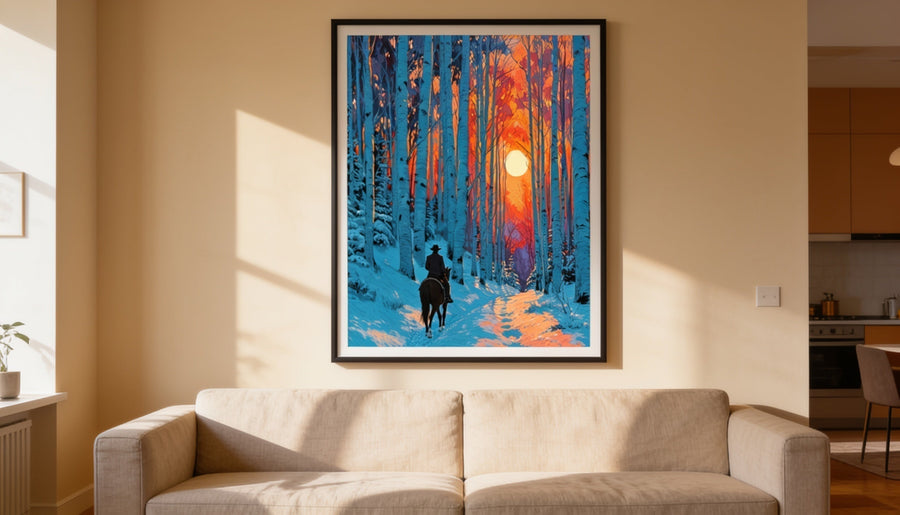
For wall art placement, the Golden Ratio becomes practical: your artwork should look visually connected to the furniture below it. In most homes, this means choosing art that is about 60% to 70% of the furniture width. This overlaps with the popular 2/3 rule for wall art, which says art should cover roughly two-thirds of the sofa, bed, console, or credenza below it.
| Placement rule | Formula | Use it for |
|---|---|---|
| Golden Ratio-inspired rule | Furniture width × 0.62 | A precise target for art width |
| 2/3 rule for wall art | Furniture width × 0.67 | Sofas, beds, consoles, credenzas |
| Height rule | Center at 57–60 inches from floor | Open walls and gallery-style hanging |

What Is the Golden Ratio?
The Golden Ratio, often represented by the Greek letter φ (Phi), is a mathematical relationship roughly equal to 1.618. It is discussed in art, architecture, photography, nature, and design because it describes a relationship between a smaller part and a larger whole.
For decorating, you do not need complicated equations. The useful principle is simpler: your art should feel clearly connected to the furniture, wall, and space around it.

Golden Ratio Cheat Sheet for Wall Art
Measure the furniture below your art, then look for a piece or grouping that lands near the recommended width.
| Furniture width | Ideal art width | Useful setup |
|---|---|---|
| 40 in console | 24–28 in | One 24x36 print |
| 60 in credenza | 36–42 in | One large print or two smaller pieces |
| 72 in sofa | 43–50 in | Two 24x36 prints or a tight gallery pair |
| 84 in sofa | 50–58 in | Two 24x36 prints or a larger gallery wall |
A single 24x36 print can work beautifully over narrow furniture. Over a large sofa, it often needs a partner or gallery arrangement so the total composition does not feel undersized.
60/40 Art Placement Calculator: The Static Formula
The former interactive planner can be reduced to one reliable calculation: furniture width × 0.6 ≈ target art width. For example, an 84-inch sofa suggests roughly 50 inches of total art width. Use one large piece, a pair, or a gallery arrangement that lands near that target.
How to Use the 60/40 Rule on Your Walls
When hanging art above a console, credenza, bed, or sofa, aim for artwork that takes up about 60% of the furniture width. A 40-inch entryway table pairs naturally with about 24 inches of art width. If the art is much wider than the furniture it can feel top-heavy; if it is much smaller, it can look disconnected.
For a very wide sofa, use two large pieces, a diptych, or a gallery arrangement rather than stretching a small digital file beyond its useful resolution. See our aspect ratio guide for digital art when choosing print dimensions.
Wall Art Placement by Room: Sofa, Bed, Console & Hallway
| Location | Best art width | Placement tip |
|---|---|---|
| Above sofa | 60%–70% of sofa width | Hang 6–10 inches above the sofa back |
| Above bed | 60%–75% of headboard width | Keep the bottom roughly 8–12 inches above the headboard |
| Above console | 60%–70% of console width | A single 24x36 print often works well on narrower furniture |
| Hallway or open wall | Use wall width and viewing distance | Center artwork around 57–60 inches from the floor |
Golden Ratio Picture Frame Sizing
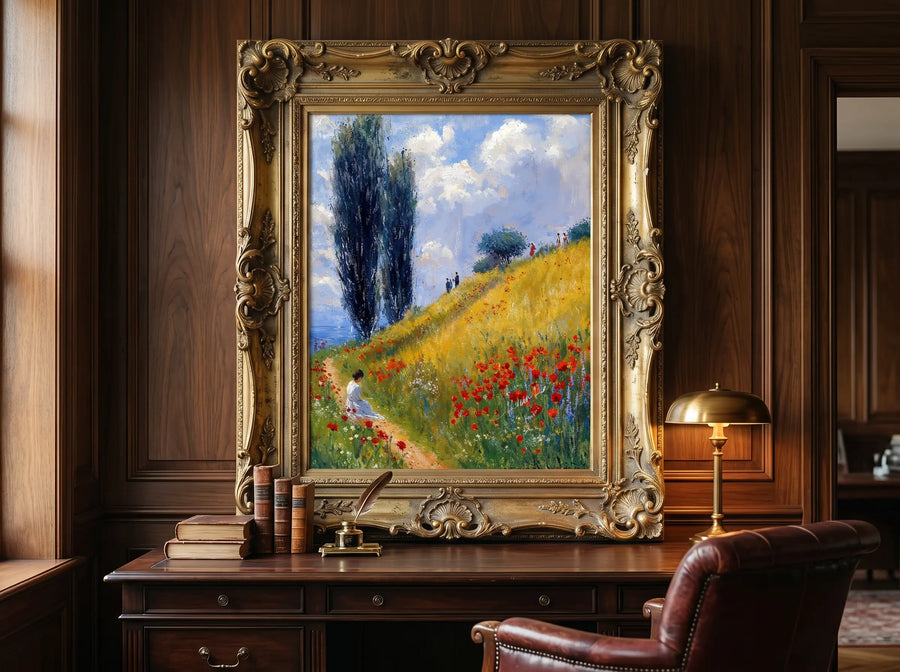
Include the frame and mat in the final visual width. A 24x36 print inside a mat and frame may read closer to 28x40 on the wall. Choose the print first, then a frame that supports the artwork without making the total composition too wide.
Building Visual Rhythm
The Fibonacci sequence is closely associated with discussions of the Golden Ratio. In a gallery wall, the practical lesson is variation with structure: one larger anchor, supporting medium pieces, and smaller accents can create rhythm without forcing every frame into an identical grid.

For a step-by-step layout system, see our gallery wall layout guide.
Why Proportion Can Make a Room Easier to Read
Visual balance, grouping, scale, and spacing affect how quickly we understand a composition. In practical interior design, proportion reduces visual friction: the furniture relates to the wall, the art relates to the furniture, and the spacing feels intentional.
Why 24x36 Works So Well
A 24x36 print uses a 2:3 aspect ratio. Its 24-inch width can anchor narrower furniture, while two 24x36 prints can create the broader total width needed above a larger sofa or bed. The right choice still depends on the furniture width and the complete framed dimensions.
Common Proportion Mistakes
- Choosing art that is too small: tiny art above a large sofa can look disconnected.
- Hanging art too high: excessive space above furniture breaks the visual relationship.
- Ignoring total arrangement width: measure the outside width of the whole grouping.
- Using one piece when the wall needs a pair or grouping: scale the composition to the furniture.
- Forgetting the frame: mats and frames add visual width and weight.
Frequently Asked Questions
What is the 2/3 rule for wall art?
The artwork or art grouping should be roughly two-thirds as wide as the furniture below it. An 84-inch sofa, for example, suggests about 56 inches of total art width.
How do I use the Golden Ratio for wall art placement?
Measure the furniture below the artwork, multiply its width by about 0.62 to 0.67, then choose a single piece or grouping near that width.
What size art should go above a bed?
Art above a bed often looks balanced at about 60% to 75% of the headboard width, with the bottom edge roughly 8 to 12 inches above the headboard.
Does the Golden Ratio apply to picture frames?
Use the idea practically: include the frame and mat in the final visual width, then compare that total width with the furniture below it.
Final Thoughts: Finding Balance
Good wall-art proportion does not require perfect mathematics. Measure the furniture, aim for roughly 60% to 70% of its width, keep the artwork visually connected to what sits below it, and choose a single piece or grouping that fits the room.
Ready to build a balanced wall? Explore our best-selling fine art prints or continue with the Gallery Wall Layout Guide.
Art worth living with


