

Blog Posts
How High Should You Hang Wall Art? The Museum Standard Explained
A guide to hanging your wall art perfectly.
 Apr 22, 20267 min read
On this page
Quick answer: On an open wall, a useful starting point is to place the center of the artwork about 57 inches (145 cm) from the floor. This is a practical eye-level guideline. Above furniture, use the furniture as the visual anchor instead: keep the bottom of the frame roughly 6–8 inches above a sofa or console and about 8–12 inches above a headboard. For gallery walls, treat the full arrangement as one composition and center the group around the same eye-level zone.
Hanging art well is less about finding one perfect number than about making the artwork feel connected to the room. The 57-inch rule is a practical eye-level guideline for open walls, but furniture, frame size, seating, and the overall composition can change the best placement.
The key idea is simple: judge the artwork by its visual center, not by the nail or the top edge of the frame. Once you separate the final center height from the hardware position, picture hanging becomes much easier to calculate.
How High Should You Hang Art?
For artwork on an open wall, start by placing the artwork's vertical center at about 57 inches from the floor. This is often called the 57-inch rule. It is a starting point, not a law: the best final placement should still make sense for the room and the people using it.
| Situation | Starting Point | What Matters Most |
|---|---|---|
| Open wall | Center around 57 in / 145 cm | Comfortable eye-level viewing |
| Above sofa or console | Bottom about 6–8 in above furniture | Keep art visually connected to furniture |
| Above headboard | Bottom about 8–12 in above headboard | Avoid a floating gap |
| Gallery wall | Center the whole group around eye level | Treat the arrangement as one composition |
Why the 57-Inch Rule Works
The rule works because it gives you a consistent eye-level reference point. The important phrase is "on center": the center of the artwork sits near 57 inches, not the nail, top edge, or bottom edge.
That distinction is especially useful with larger frames. A 24×36-inch vertical piece can have a nail well above 57 inches while the artwork itself is still centered at 57 inches.
If you prefer art slightly higher or lower, adjust by a few inches after considering the room. Consistency matters more than treating 57 inches as an absolute requirement.
Picture Hanging Height Cheat Sheet
| Placement | Recommended Starting Point | Why |
|---|---|---|
| Standalone artwork | Center around 57 in | Creates a consistent eye-level reference |
| Above sofa | 6–8 in above sofa | Connects artwork to the furniture below |
| Above console or credenza | 6–8 in above surface | Prevents a large floating gap |
| Above headboard | 8–12 in above headboard | Keeps the grouping visually unified |
| Dining room | About 54–57 in on center | A slightly lower placement can suit seated viewing |
| Gallery wall | Center the group around 57 in | Makes many frames read as one composition |
The Nail Height Formula
Do not put the nail at 57 inches. The nail usually needs to sit higher because the artwork's center is below the top of the frame.
Nail Height = Target Center Height + (Frame Height ÷ 2) − Wire Drop
Wire drop is the distance from the top edge of the frame to the hanging wire when the wire is pulled upward as it will sit on the hook.
Example: A 36-inch-tall frame centered at 57 inches with a 2-inch wire drop gives: 57 + 18 − 2 = 73 inches. The nail goes 73 inches from the floor while the artwork center lands at 57 inches.
Nail Height Examples for Common Frame Sizes
These examples assume a 57-inch center height and a 2-inch wire drop. Your actual wire drop may be different, so measure the hardware on your frame before making a final hole.
| Vertical Frame | Formula | Example Nail Height |
|---|---|---|
| 11×14 | 57 + 7 − 2 | 62 in |
| 16×20 | 57 + 10 − 2 | 65 in |
| 18×24 | 57 + 12 − 2 | 67 in |
| 24×36 | 57 + 18 − 2 | 73 in |
How High to Hang Art Above a Couch
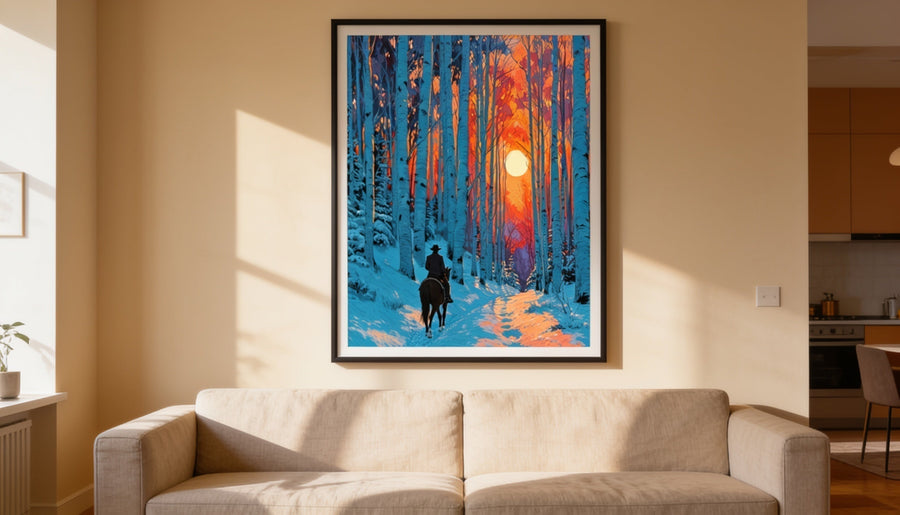
Above a sofa, the furniture becomes the visual anchor. A practical starting point is to keep the bottom of the frame about 6–8 inches above the sofa. If the gap becomes much larger, the art can begin to feel detached from the seating area.
Scale matters too. The artwork or grouping should generally feel substantial enough for the furniture below it. For width guidance, see our 2/3 rule for wall art sizing.
Room-by-Room Hanging Height Guide
| Room or Location | Starting Point | Adjustment |
|---|---|---|
| Living room open wall | 57 in on center | Adjust for the room's main standing/seated view |
| Above sofa | 6–8 in above sofa | Check artwork width against sofa width |
| Above bed | 8–12 in above headboard | Keep the arrangement connected to the bed |
| Above console | 6–8 in above surface | Allow for lamps and decorative objects |
| Dining room | 54–57 in on center | Consider seated sightlines |
| Hallway | Around 57 in on center | Use a consistent center line across multiple pieces |
How High Should a Gallery Wall Be?
Treat a gallery wall as one large composition rather than centering every frame individually at 57 inches. Find the visual center of the full arrangement and place that center near your chosen eye-level line.
- Gallery wall on an open wall: center the overall group around 57 inches.
- Gallery wall above a sofa: prioritize the bottom gap above the sofa, then balance the full arrangement upward.
- Staircase gallery: follow the rise of the stairs rather than forcing a horizontal 57-inch line.
For spacing and composition, see our guide to planning a gallery wall.
Should You Hang Art Higher With High Ceilings?
Usually, no. Taller ceilings do not automatically mean the artwork should move upward. If a single frame looks undersized on a tall wall, a better solution is often larger artwork, a pair of pieces, or a gallery wall rather than raising the frame beyond a comfortable viewing height.
Common Art Hanging Mistakes
Hanging art too high: if the piece feels detached from the furniture and activity below it, lower it before changing anything else.
Measuring to the top of the frame: plan the final artwork center first, then calculate the hardware position.
Forgetting the wire drop: this can move the finished artwork several inches away from the intended center line.
Using 57 inches above furniture without checking the gap: above sofas, beds, and consoles, the furniture relationship usually matters more.
Raising art just because the ceiling is tall: use more visual scale instead of automatically moving one frame upward.
Frequently Asked Questions
What is the 57-inch rule for hanging pictures?
It is a common guideline that places the vertical center of artwork about 57 inches from the floor. It works best as a starting point for artwork on an open wall.
Do I put the nail at 57 inches?
No. The artwork center goes near 57 inches. The nail or hook usually sits higher. Use: target center height + half the frame height − wire drop.
How high should art be above a couch?
Start with the bottom of the frame roughly 6–8 inches above the sofa, then check the relationship from normal viewing distance.
How high should art be above a bed?
A useful starting range is about 8–12 inches above the headboard. The goal is to make the artwork and bed read as one visual grouping.
How high should a 24×36 print be hung?
On an open wall, center the 36-inch-tall artwork around 57 inches. With a 2-inch wire drop, the example nail height is 73 inches. Measure your actual hardware before marking the wall.
Does the 57-inch rule apply to gallery walls?
Use it as a starting point for the center of the entire arrangement, not for every individual frame.
Hang It Once, Then Check the Room
The simplest method is to start with the artwork center around 57 inches on an open wall, calculate the hardware position correctly, and then judge the result in context. Above furniture, let the furniture guide the placement. For a gallery wall, treat the whole arrangement as one composition.
If you are also deciding how wide the artwork should be, continue with our wall art sizing guide. For multi-frame arrangements, use the gallery wall planning guide.
Art worth living with


