Spatial Planning & Geometry
The 2/3 Rule for Wall Art: Sofa, Bed & Gallery Wall Sizing Guide
The rule of proportion in art is the single most important principle for hanging wall art correctly. Whether you are choosing art for above a sofa, a bed, or an empty wall, proper proportion determines whether your space feels balanced and curated — or visually chaotic. This complete art proportion guide gives you the exact mathematics, room-by-room measurements, and interactive tools to get it right every time.
Use the 2/3 wall art rule to choose the right artwork size above a sofa, bed, console, fireplace, or gallery wall. Includes exact width charts, 24x36 examples, diptych math, and visual weight guidance.
In residential design, an improper spatial relationship between a primary architectural anchor (such as a sofa) and its corresponding artwork induces immediate visual dissonance. We have all witnessed the phenomenon: a premium, heavy credenza stationed against a vast wall, surmounted by a single, diminutive frame floating in the upper hemisphere. In design vernacular, this is diagnosed as the "postage stamp" effect. Regardless of the artwork's intrinsic value, a failure in scale renders the entire environment structurally disconnected and chaotic.
Curating a minimalist or Scandinavian interior is a precise exercise in thermodynamic balance. A massive focal point resting on the floor demands an equivalent "visual mass" suspended on the wall above it to stabilize the room's gravity. To resolve this geometric dilemma without subjective guesswork, professional architects and curators deploy an absolute mathematical standard: the 2/3 Proportion Rule.
In this technical protocol, we will deconstruct the physics of visual weight, outline how to scale multiple frames flawlessly, and demonstrate the exact arithmetic required to permanently anchor your space.
Quick Answer: What Is the 2/3 Rule for Wall Art?
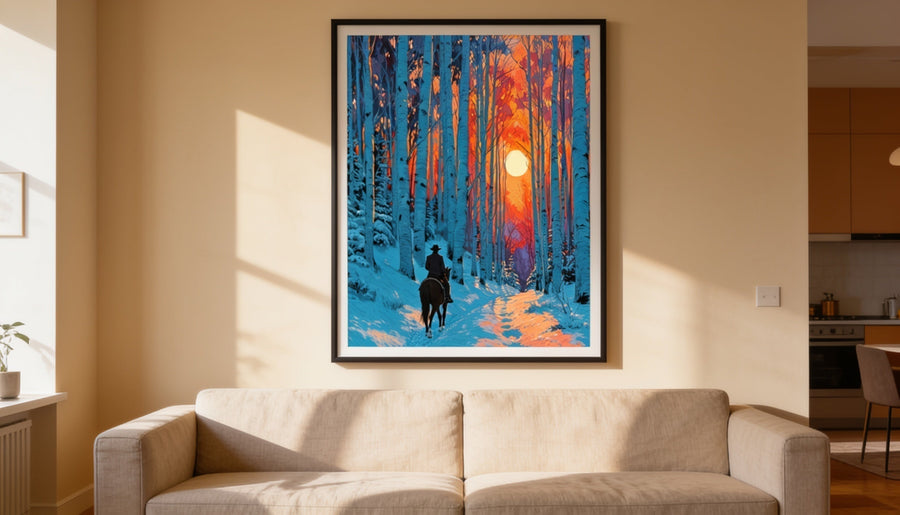
The 2/3 rule for wall art means your artwork should be about two-thirds the width of the furniture below it. If your sofa is 72 inches wide, your art arrangement should be roughly 48 inches wide at minimum and can comfortably extend toward 54 inches.
This rule works because the artwork stays slightly narrower than the furniture, creating a stable visual pyramid. The furniture becomes the base. The art becomes the focal point. The room feels intentional instead of floating, undersized, or visually top-heavy.
The Wall Art Size Formula
The fastest way to size art above furniture is to multiply the furniture width by 0.67. That gives you the minimum artwork width. For a more generous designer look, multiply by 0.75.
| Measurement | Formula | Example |
|---|---|---|
| Minimum art width | Furniture width × 0.67 | 72" sofa × 0.67 = 48" art width |
| Designer range | Furniture width × 0.67 to 0.75 | 72" sofa = 48" to 54" art width |
| Gallery wall width | All frame widths + gaps | Two 24" prints + 3" gap = 51" total span |
For vertical placement, pair this sizing formula with the 57-inch museum height rule. Width creates balance. Height creates eye-level comfort.
Quick Guide to Geometric Scaling
-
The 2/3 Geometric Ratio: The aggregate width of your artwork installation must consume approximately 66% to 75% of the total width of the furniture anchored directly beneath it.
-
Modular Expansion: If a singular frame fails to bridge the 66% threshold, do not artificially stretch the print. Deploy a diptych or triptych to construct the required horizontal volume.
-
Calculated Visual Mass: Deeply saturated, low-key palettes generate heavier perceived gravity than high-key, minimalist prints. Darker subjects can anchor a space even at slightly reduced physical dimensions.
-
The 24x36 Absolute Authority: Because we strictly cap our catalog at a massive 24x36 maximum offering, this dimension operates as the ultimate solo anchor for standard seating and credenzas.
Geometric Stability: The 2/3 Mechanism
The 2/3 rule operates as an accessible, interior-focused derivative of the Golden Ratio. It dictates that for a vertical plane to achieve structural harmony, the horizontal span of the artwork must equal approximately 66% to 75% of the foundational furniture's width.
Why does this specific percentage govern spatial design? It engineers a stable geometric pyramid. Because the artwork remains slightly narrower than the base structure, the visual weight slopes inward, mimicking solid load-bearing architecture. If an artwork extends to the exact edge of the sofa—or eclipses it—the geometry inverts. The composition becomes "top-heavy," generating an anxious, subconscious perception that the installation is actively tipping over.
Interactive Simulator: Calculate Your Ratio
Eliminate the arithmetic. Utilize our diagnostic engine to establish your baseline proportions. Select your foundational furniture and configure the artwork dimension. Observe how the 24x36 absolute scale satisfies standard residential configurations.
Visual Weight & Proportion Analyzer
Diagnose the structural stability between your furniture base and artwork volume.
The Art Proportion Rule, Room by Room
The 2/3 proportion rule in art adapts to every room in your home. Here is the precise application for each space — including exact measurements in both inches and centimeters.
Above a Sofa (Living Room)
This is the most common application of the art proportion rule. Measure your sofa's width and multiply by 0.67 to get the minimum artwork width.
| Sofa Width | Minimum Art Width | Ideal Art Width |
|---|---|---|
| 60" (152 cm) | 40" (102 cm) | 40–45" (102–114 cm) |
| 72" (183 cm) | 48" (122 cm) | 48–54" (122–137 cm) |
| 84" (213 cm) | 56" (142 cm) | 56–63" (142–160 cm) |
| 96" (244 cm) | 64" (163 cm) | Use diptych or triptych |
Height placement: The bottom edge of your artwork should sit 6–10 inches (15–25 cm) above the sofa back. The center of the artwork should hang at approximately 57–60 inches (145–152 cm) from the floor — standard eye level.
Above a Bed (Bedroom)
The bed frame width, not the mattress, is your reference measurement for the art proportion rule in a bedroom setting.
| Bed Size | Frame Width | Ideal Art Width |
|---|---|---|
| Twin | 39" (99 cm) | 26–30" (66–76 cm) |
| Full/Double | 54" (137 cm) | 36–40" (91–102 cm) |
| Queen | 60" (152 cm) | 40–45" (102–114 cm) |
| King | 76" (193 cm) | 50–57" (127–145 cm) — or two 24x36 as a diptych |
Height placement: Leave 6–8 inches (15–20 cm) above the headboard before beginning your artwork. This creates visual breathing room without disconnecting the art from the bed.
Above a Fireplace
The fireplace mantel width is your anchor measurement. Apply the 2/3 proportion rule to the mantel, not the full fireplace surround.
- Standard mantel (48"): Artwork 32–36" wide
- Wide mantel (60"): Artwork 40–45" wide
- Grand mantel (72"+): Single 24x36 or a diptych arrangement
Above a Console or Credenza
Console tables typically run 48–72 inches wide. A single 24x36 fine art print satisfies the 2/3 rule for most standard consoles. For a 72-inch credenza, use a 48-inch piece or pair two 24x36 prints with a 2-inch gap.
Dining Room Feature Wall
In a dining room without furniture anchor, apply the 4/7 void protocol described later in this guide. For art above a sideboard or buffet, the 2/3 rule applies using the buffet width as your reference.
Art Proportion Quick Reference Chart
Use this chart as your instant reference for the art proportion rule. Measurements apply to single artwork installations above standard furniture.
| Furniture Width | Single Print Size | Diptych Option | Best Art Academi Size |
|---|---|---|---|
| 48" sofa / console | 16x20 or 18x24 | — | 16x20 (Medium) |
| 60" sofa / queen bed | 24x30 or 24x36 | Two 16x20 | 24x36 (Large) |
| 72" sofa | 24x36 (ideal) | Two 18x24 | 24x36 (Large) |
| 84" sofa | 24x36 + visual mass | Two 24x36 | Two 24x36 Diptych |
| King bed (76") | 24x36 (minimum) | Two 24x36 | Two 24x36 Diptych |
Note: Our largest print is 24x36 inches. For spaces requiring wider coverage, a diptych (two prints side by side with a 3-inch gap) creates the necessary horizontal span without sacrificing print quality.
Ready to find your size? Browse our collection of fine art prints — available from 8x10 up to 24x36.
Art Proportion Rule in Centimeters
For our European customers, here is the complete art proportion guide in centimeters. The 2/3 rule applies identically — simply replace inches with centimeters in your calculations.
| Furniture Width (cm) | Minimum Art Width (cm) | Ideal Art Width (cm) |
|---|---|---|
| 150 cm (standard sofa) | 100 cm | 100–112 cm |
| 180 cm (wide sofa) | 120 cm | 120–135 cm |
| 210 cm (large sofa) | 140 cm | 140–157 cm |
| 240 cm (sectional) | 160 cm | Use diptych arrangement |
Common European frame sizes and their Art Academi equivalents:
- 40x50 cm ≈ 16x20 inches (Medium)
- 50x70 cm ≈ 20x28 inches (between Medium and Large)
- 60x90 cm ≈ 24x36 inches (Large — our maximum)
When ordering from Europe, our prints ship in inches but we are happy to confirm the exact centimeter dimensions for your framing needs. Contact us and we will provide the precise measurements for any print in your preferred unit.
The Physics of Visual Mass
Architectural curation relies on more than linear dimensions; it demands an understanding of "Visual Mass." Visual mass defines the perceived gravity of an object within the visual field. Strategic manipulation of this mass permits precise deviations from the strict 2/3 geometric formula.
When orchestrating visual mass, integrating pieces restricted to three dominant colors prevents chromatic chaos and sustains a minimalist, Scandinavian harmony. A dense, dark 24x36 frame will visually anchor a larger space than a pale, unstructured watercolor of the exact same physical size.
Visual Weight Variance Matrix
| Aesthetic Element | Low Visual Mass (Light) | High Visual Mass (Heavy) |
|---|---|---|
| Pigment Saturation | High-key pastels, expansive white negative space. | Deeply saturated blacks, heavy contrast, moody lighting. |
| Hardware (Framing) | Thin, raw oak or minimalist aluminum channels. | Thick, ornate, matte black or solid walnut moldings. |
| Color Complexity | Unstructured or chaotic polychromatic palettes. | Strict adherence to the 3-dominant-color rule. |
Test Heavy Visual Mass Tonight—For Free
Experience the anchoring power of high-density pigment. Download my complimentary printable artwork, "The Ninth Gate". This piece uses deep atmospheric saturation to provide a heavy, perfectly balanced visual mass that effortlessly anchors large furniture without requiring massive physical dimensions. Download it today.
Modular Scaling (Diptychs & Triptychs)
If the foundational architecture is an expansive 96-inch modular sofa, a solitary 24-inch print will inevitably collapse under the scale. However, forcefully upscaling a file beyond its native resolution destroys pixel density. The architectural solution is Modular Expansion.
By suspending two corresponding 24x36 prints (a Diptych) separated by a strict 3-inch negative space corridor, you generate an aggregate width of 51 inches (24 + 3 + 24). This effortlessly satisfies the 66% ratio for massive sectionals.
Void Architecture: The 4/7 Rule
How do you dictate proportion in an environment devoid of a physical anchor? When curating an unobstructed plane—such as an entryway corridor or an expansive dining wall—designers pivot from the 2/3 ratio to the 4/7 Void Protocol.
The mathematics dictate that the horizontal boundary of the art installation must consume slightly more than half (57%) of the empty wall width. For a 120-inch (10-foot) expanse of drywall, the aggregate width of your gallery should range between 68 and 70 inches. This creates a definitive focal point, terminating the optical drift that occurs in empty rooms.
Best Art Sizes Above a Sofa
For searchers asking how big art should be above a couch, the answer depends on the width of the sofa. The chart below gives practical ranges you can use immediately.
| Furniture Width | 2/3 Art Width | Best Art Setup |
|---|---|---|
| 60" sofa | 40" to 45" wide | One large horizontal piece or one strong 24x36 print |
| 72" sofa | 48" to 54" wide | Two 24x36 prints with a 3" gap, or a single extra-wide piece |
| 84" sofa | 56" to 63" wide | Triptych, gallery wall, or panoramic statement art |
| 96" sectional | 64" to 72" wide | Large gallery wall or three-panel arrangement |
For the cleanest result, keep the artwork centered over the furniture and leave a narrow negative-space bridge between the bottom of the frame and the furniture top. The art should feel connected to the sofa, not stranded above it.
Common Wall Art Sizing Mistakes
- Choosing one small print above a wide sofa: this creates the postage stamp effect and weakens the room's center of gravity.
- Ignoring the total width of a gallery wall: the full arrangement, including gaps, must satisfy the 2/3 rule.
- Using height instead of width as the main anchor: proportion is primarily judged by horizontal span above furniture.
- Letting artwork become wider than the sofa: this makes the wall feel top-heavy and unstable.
- Forgetting visual weight: dark, saturated artwork feels heavier than pale minimalist artwork, even when both pieces are the same size.
Neuro-Aesthetics: Why Balance Lowers Cortisol
Enforcing geometric rules is not a pedantic exercise in decoration; it is an intervention in environmental psychology. The human visual cortex constantly surveys its surroundings, scanning for structural instability as a primal threat vector. When an interior registers as "top-heavy" or asymmetrical, the brain subconsciously interprets the environment as hazardous, sustaining elevated cortisol levels.
Executing the 2/3 proportion rule establishes irrefutable symmetry. It engineers an environment that signals stability and permanence, permitting the occupant to bypass the threat-assessment phase and immediately enter a state of psychological recovery.
Frequently Asked Questions
How big should art be over a couch?
As a strict architectural baseline, the total horizontal span of your artwork should equal approximately 2/3 (or 66%) of the width of the furniture anchored beneath it. This prevents the display from appearing disjointed or top-heavy.
What is the 'postage stamp' effect in interior design?
The postage stamp effect is a severe structural imbalance occurring when an undersized piece of art is suspended above a massive piece of furniture. The art loses its anchoring authority, rendering the entire wall disjointed and visually chaotic.
Can I hang multiple frames over a wide sofa?
Absolutely. If a single rigid piece cannot satisfy the 66% width requirement, deploying a diptych (two panels) or triptych (three panels) establishes the necessary horizontal volume to properly balance the furniture's mass.
What is the rule of proportion in art?
The rule of proportion in art refers to the mathematical relationship between the size of an artwork and its surrounding environment. In interior design, the most widely applied version is the 2/3 proportion rule: artwork should cover approximately 66–75% of the width of the furniture it hangs above. This creates visual balance and prevents the "postage stamp" effect where undersized art floats disconnected above a large piece of furniture.
What size art should go above a 72-inch sofa?
For a 72-inch (183 cm) sofa, apply the 2/3 proportion rule: 72 × 0.67 = 48 inches minimum width. A single 24x36 inch fine art print satisfies this requirement at the top of its range. For perfect coverage, consider a diptych of two 24x36 prints separated by a 3-inch gap, creating a 51-inch aggregate span that sits beautifully within the 2/3 threshold.
How do you calculate visual weight in art placement?
Visual weight in art placement is calculated by combining the physical dimensions of an artwork with its chromatic density. A deeply saturated, dark artwork generates more perceived gravity than a pale, minimalist piece of identical physical size. To calculate your ideal visual weight: (1) measure your furniture width and multiply by 0.67 for the baseline artwork width, then (2) if using a smaller print, choose a piece with high chromatic density — deep blacks, saturated colors, high contrast — to compensate for reduced linear dimensions.
Is the 2/3 rule the same as the golden ratio?
The 2/3 rule (66%) is an accessible interior design derivative of the golden ratio (61.8%). While not mathematically identical, both ratios produce the same perceptual effect: a stable, harmonious relationship between two elements that feels neither top-heavy nor disconnected. Professional architects use the golden ratio for structural design; interior designers use the simplified 2/3 rule for practical furniture-to-artwork scaling.
What is the correct height to hang art above a sofa?
The bottom edge of artwork above a sofa should sit 6–10 inches (15–25 cm) above the sofa back. The center of the artwork should align with approximately 57–60 inches (145–152 cm) from the floor — the average human eye level. This dual measurement ensures the art is visually connected to the furniture while remaining at a comfortable viewing height. For the complete vertical placement protocol, see our 57-inch museum height guide.
Final Thoughts: Calculate the Anchor
The culmination of a sophisticated interior relies entirely on spatial mathematics. By eschewing guesswork and rigorously enforcing the 2/3 Proportion Rule, you transition a room from merely decorated to flawlessly engineered.
Whether you are stabilizing a vast sectional or commanding an empty corridor, trust the geometry. When scale achieves equilibrium, visual noise is eradicated. Ensure you pair this dimensional control with the proper vertical alignment outlined in our 57-inch museum height protocol.
Is your space suffering from structural imbalance? Execute a modular upgrade. Explore our collection of 24x36 fine art prints and establish geometric harmony today.
Similar articles
Rental-Friendly Wall Art Ideas: No-Damage Ways to Make a Rental Feel Like Home
A practical, design-led guide to styling rental-friendly wall art with no-damage hanging methods.
How to Frame Digital Art on a Budget: High-End Looks for Less
A guide to framing your digital art for less.
Bathroom and Kitchen Wall Art: How to Protect Your Prints
A guide to hanging art in kitchens and bathrooms.
Calming Bedroom Art Ideas: How to Create a Sleep Sanctuary
A guide to choosing relaxing art for your bedroom.