

Blog Posts
Structural Integrity: The Technical Benefits of Sealed Frame Backings
A guide to protecting your art from the back.
 Apr 22, 20267 min read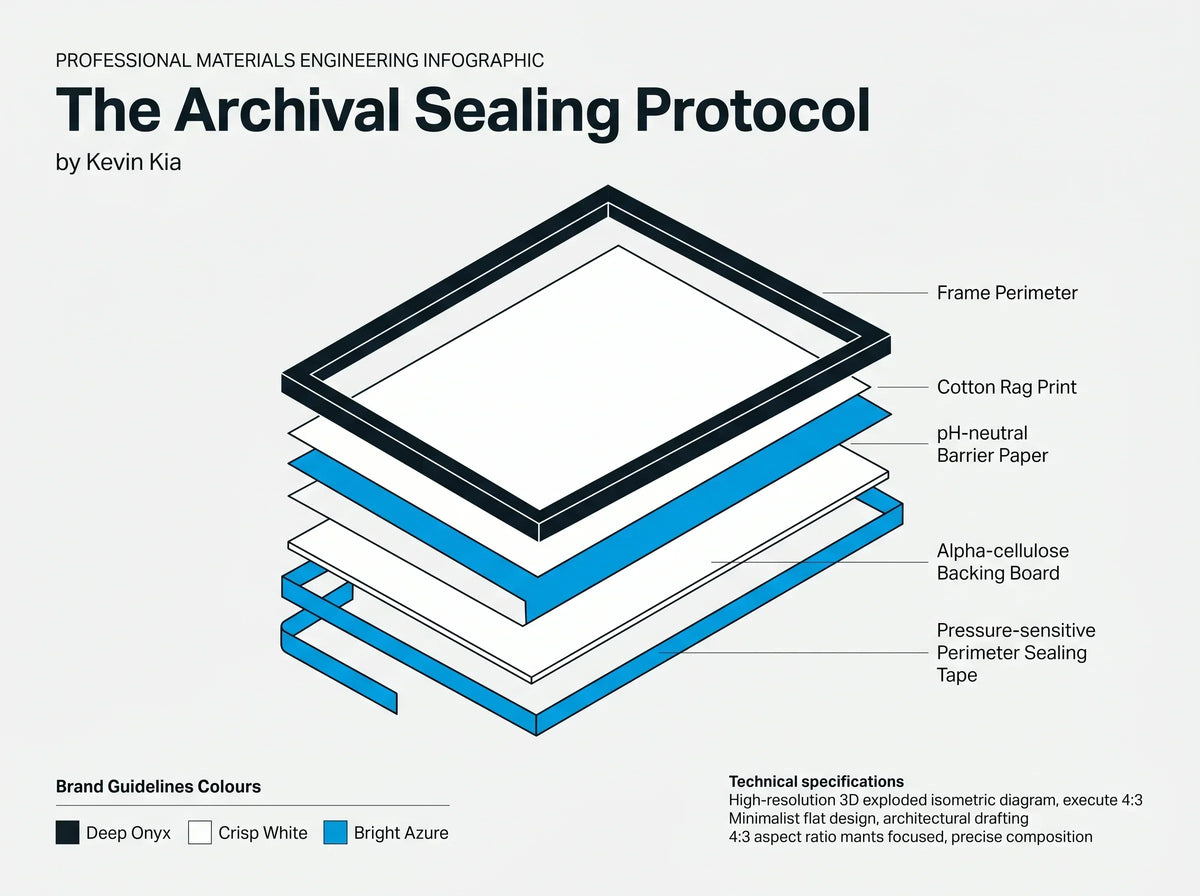
On this page
Archival Engineering & Preservation
Structural Integrity: The Technical Benefits of Sealed Frame Backings
Master the science of archival preservation. Learn why sealing the back of a picture frame is an architectural necessity to protect fine art prints from barometric dust infiltration, biological pests, and chemical acid migration.
When evaluating a curated interior, our visual cortex naturally focuses on the outward presentation—the brilliant tonal accuracy, the tactile texture of the 100% cotton rag, and the crisp geometric lines of the molding. However, consult any professional archivist or museum conservator, and they will confirm a strict engineering reality: the most critical preservation work occurs entirely out of sight, on the rear of the frame.
The reverse side of your hardware is the foundational barrier of your artwork’s defense system. If this boundary is neglected, the premium print suspended on your wall is completely exposed to barometric particulate infiltration, biological pests, and insidious chemical degradation. Leaving a frame unsealed is the architectural equivalent of securing the front door to a vault while leaving the rear entirely open.
In this technical protocol, we will deconstruct the physics and chemistry of frame backing. We will outline why establishing a hermetic seal is the ultimate, non-negotiable requirement for guaranteeing your investment remains immaculate for generations.
Quick Guide to Archival Backings
-
Particulate Defense: Unsealed retail frames act as barometric vacuums, continuously pulling airborne dust and soot across the artwork. A sealed dust cover permanently halts this air exchange.
-
Biological Exclusion: Micro-pests (such as silverfish) actively consume unprotected cotton cellulose. A bonded kraft paper seal establishes an impenetrable physical fortress against biological intrusion.
-
Preventing Acid Migration: Standard brown cardboard bleeds highly corrosive lignin acids into fine art paper over time. Utilizing strictly pH-neutral, acid-free foam core is a structural imperative.
-
Mechanical Rigidity: At our massive 24x36 inch scale, frames require immense torsional support. A dense, sealed backing board prevents bowing and ensures the glazing package remains perfectly flat.

Structural Comparison: Retail vs. Archival
The disparity between a temporary retail frame and a permanent architectural installation lies primarily in the rear construction. Review this technical matrix to ensure your framing hardware meets conservation standards.
| Component | Standard Retail Frame | Archival Sealed Frame |
|---|---|---|
| Backing Material | Corrugated Cardboard (Acidic) | pH-Neutral Foam Core |
| Securing Mechanism | Flexible Metal Tabs (Creates Gaps) | Rigid Framer's Points |
| Environmental Seal | None (Open Air Exchange) | Bonded Kraft Paper Dust Cover |
| Tape Application | Standard Masking Tape (Dries/Fails) | Acid-Free Acrylic Adhesive Tape |
| Calculated Lifespan | 1 to 3 Years (Before Yellowing) | 50+ Years (Archival Stability) |
The Physics of the Vacuum Effect
Inexpensive frames sourced from standard craft retailers typically rely on a sheet of thin cardboard held under tension by flexible metal brads. Architecturally, this structure is defined as a "leaky" enclosure. It possesses microscopic gaps spanning the entire perimeter where the backing substrate meets the wooden molding.

As ambient temperature and barometric pressure fluctuate throughout the diurnal cycle, the air trapped inside the frame expands and contracts. Because the enclosure is unsealed, it acts as an atmospheric pump—literally inhaling fine dust, kitchen soot, airborne lipids, and microscopic skin cells from the room. Over time, these particulates settle onto the face of the print, permanently dulling the contrast and shifting whites to a dingy grey.
Deploying a continuous kraft paper "dust cover" bonded across the rear perimeter completely neutralizes this vacuum effect. It halts all external air exchange, guaranteeing the 12-color pigment print remains housed in an immaculate, static micro-climate.
Secure Your Collection Tonight—For Free
Experience the pristine depth of an image untouched by environmental degradation. Download my complimentary printable artwork, "The Ninth Gate". This piece is specifically mastered with subtle tonal gradients that test your framing's ability to maintain optical clarity. Download it instantly and secure your own museum-grade print.

Chemical Threat: Acid Migration
As established in our technical documentation on pH-neutral archival standards, acidity is the apex predator of fine art reproduction. You may invest heavily in a flawless, acid-free cotton rag print, but if you install highly acidic materials directly behind it, structural failure is inevitable.

Standard retail frames rely on industrial brown cardboard to secure the print. Cardboard is manufactured with heavy concentrations of lignin, a highly acidic organic polymer. Through a passive chemical transfer known as Acid Migration, these corrosive acids bleed through the layers, penetrating the rear of your print and aggressively oxidizing the cotton fibers. You must categorically reject cardboard backings. Mandate the use of rigid, pH-neutral foam core and acid-free barrier papers to maintain absolute chemical stability.
Biological Defense Mechanisms
While aesthetically unpleasant, it is a biological reality: premium 100% cotton cellulose is a primary food source for micro-pests such as silverfish and booklice. These organisms actively seek out dark, confined, unsealed crevices behind wall hangings.

If a frame relies solely on loose metal tabs without a unified rear membrane, insects possess unrestricted access to the substrate. Affixing a continuous, tensioned dust cover across the entire rear geometry eliminates all infiltration vectors, transforming your decorative frame into an impenetrable fortress.
Load-Bearing Architecture at 24x36
Our studio engineering strictly caps all fine art prints at a 24 by 36 inch maximum limit. At this massive architectural scale, framing hardware experiences substantial sheer weight and torsional stress. Without proper structural reinforcement, wooden moldings will twist, and large acrylic glazing will begin to visibly bow inward.

A professional, high-density backing board—specifically 3/16" or 1/4" acid-free foam core—functions as the frame's mechanical spine. It forces the external molding to remain perfectly true and square, providing the structural push-back necessary to keep the delicate paper substrate pinned flawlessly flat against the front glazing.
The Archival Execution Protocol
When investing capital into residential curation, you must demand precision in the assembly phase. Whether commissioning a bespoke local build or upgrading a ready-made commercial frame, strictly enforce this three-step sealing protocol:

- The Structural Core: Mandate the use of 100% acid-free foam board. Verify the absolute removal of all corrugated cardboard from the interior housing.
- The Environmental Barrier: Ensure a continuous sheet of heavy kraft paper or Tyvek is adhered tightly across the entire rear geometry, terminating cleanly at the outer edges of the molding.
- The Chemical Bond: Standard masking tape oxidizes, dries out, and peels within 18 months. Require the use of archival, pressure-sensitive acrylic framing tape to establish a permanent, impenetrable perimeter seal.
Frequently Asked Questions
Why do picture frames have paper on the back?
The paper affixed to the rear of a frame operates as a structural dust cover. It hermetically seals the internal micro-climate, preventing airborne particulates, soot, and biological pests from infiltrating the framing package and degrading the artwork.
What is acid migration in framing?
Acid migration is a chemical degradation process. When highly acidic materials, such as standard brown cardboard, are used as backing boards, their lignin-based acids actively bleed into the fine art paper over time, causing irreversible yellowing and structural embrittlement.
Do I really need to seal the back of my frame?
Yes, absolutely. Leaving the rear of a frame unsealed exposes the archival print to rapid environmental decay. A properly sealed dust cover acts as a defensive fortress, ensuring the artwork remains pristine, flat, and chemically stable for decades.
Final Thoughts: Fortifying Your Collection
In high-end curation, the aesthetic face of the frame is merely a facade; the reverse plane dictates its permanent survival. By enforcing strict archival sealing protocols with acid-free substrates, you construct an impenetrable fortress that honors the artist's original vision.

When you construct a home gallery with materials engineered to deflect entropy, you are liberated to simply observe. The structural anxieties fade, replaced entirely by the immersive calm of the image.
Are you prepared to curate an architectural focal point? Explore our collection of museum-grade 24x36 fine art prints and secure your sanctuary today.


Art worth living with


