

Blog Posts
How to Choose Wall Art for a Dining Room: Size, Style & Placement
A practical buying guide to choosing dining room wall art by size, placement, mood and format, with real Kevin Kia artwork examples and links to deeper Art Academi resources.
 Oct 11, 20268 min read
On this page
The best dining room wall art does more than fill an empty wall. It helps set the atmosphere of the room — warm, relaxed, dramatic, bright, intimate, or quietly refined.
A useful starting point is to size the artwork in relation to the furniture or usable wall zone beneath it rather than the entire wall. For art placed above a sideboard or buffet, artwork spanning roughly 60–75% of the furniture width is often a practical starting range, although architecture, lamps, ceiling height, and the artwork itself can change what feels balanced.
The goal is not to follow a formula perfectly. It is to choose art that feels intentional in the room.
Quick answer
- Use the sideboard, table wall, or focal furniture as your visual anchor.
- Choose 16×20 for a more restrained focal point.
- Choose 24×36 when you want a stronger statement.
- Consider a pair or grouping when one artwork would look undersized on a long wall.
- Choose artwork by the feeling you want the dining room to create.
- Choose archival matte paper when you want framing flexibility.
- Choose gallery canvas when you want a stronger ready-to-hang presence.
- Test the dimensions on your wall before ordering.
Start With the Furniture, Not the Empty Wall
One of the easiest mistakes to make is choosing artwork based on the full width of the wall. In a dining room, the better visual anchor is often the furniture below it: a sideboard, buffet, console, the dining table itself, or a defined open section of wall.
If the furniture is much narrower than the wall, artwork centered to the furniture usually feels more intentional than art centered to the entire room.
A large empty wall can tempt you into buying something oversized simply because there is space available. Instead, ask: What should the artwork visually belong to?
If the answer is the sideboard, size the composition around the sideboard. If it is the table and chairs, think about the full dining arrangement. If the wall stands alone with no furniture beneath it, you have more freedom to use a larger statement piece.
What Size Wall Art Works Best in a Dining Room?
There is no single correct size, but there are useful starting points. Art Academi currently offers many works in 8×10, 11×14, 16×20, and 24×36 sizes.
| Wall situation | Size worth testing |
|---|---|
| Narrow wall or small accent area | 11×14 |
| Compact dining space | 16×20 |
| Main dining-room focal wall | 24×36 |
| Very wide sideboard or long wall | Pair or grouping |
The important word is testing. A 24×36 artwork may look substantial on one wall and surprisingly small on another.
Before ordering, use painter's tape or paper to mark the intended dimensions on the wall. Leave it in place for a day and look at it while standing, while seated at the table, from the doorway, and from the adjoining room if the dining area is open-plan.
One Large Artwork or Several Smaller Pieces?
Choose one statement piece when you want:
- a quieter, cleaner wall;
- one strong focal point;
- fewer competing visual elements;
- a more gallery-like feeling.
A single artwork is especially effective when the dining room already contains decorative lighting, patterned textiles, architectural details, or a visually strong table.
Choose a pair or grouping when:
- the wall is very wide;
- the sideboard is long;
- one available artwork would look undersized;
- you want a more collected, layered feeling.
If you choose several works, give them a clear relationship through color, subject, mood, or visual weight. For more help, see the Art Academi gallery wall guide.
How High Should Dining Room Art Hang?
Artwork should feel connected to the furniture and to the people using the room. Dining rooms are unusual because much of the experience happens while seated. Art that looks perfect from standing height can sometimes feel too high once everyone is sitting at the table.
Rather than relying on one universal number, evaluate the art from the primary viewing position. For a deeper guide, see How High Should You Hang Wall Art?
Choose the Mood Before You Choose the Artwork
A dining room is often one of the most social rooms in a home. Instead of asking what style of art is correct for a dining room, ask: How do I want this room to feel?
For a warm, intimate dining room
Look for golden light, warm reds, coral, garden color, Mediterranean architecture, and softer atmospheric depth.

Lady & Dreams uses golden light, orange walls, emerald shutters, blooming roses, and grapevines around a quiet Mediterranean courtyard scene. It can work particularly well with warm wood, cream, beige, terracotta, olive, brass, and natural textures. It is currently available in Archival Matte Paper and Gallery Canvas, from 8×10 through 24×36.
For a bright, uplifting dining room
Consider artwork with stronger daylight, floral color, open sky, fresh greens, and coastal blues.

Golden Glory brings golden wildflowers together with coastal water and a bright outdoor palette. It is currently offered as a fine-art print in sizes from 8×10 to 24×36.
For a rustic or Mediterranean dining room

Tuscany suits spaces built around wood furniture, linen, warm stone, neutral walls, rustic finishes, and Mediterranean or European-inspired interiors. It is currently offered as a fine-art print from 8×10 through 24×36.
For a romantic botanical dining room

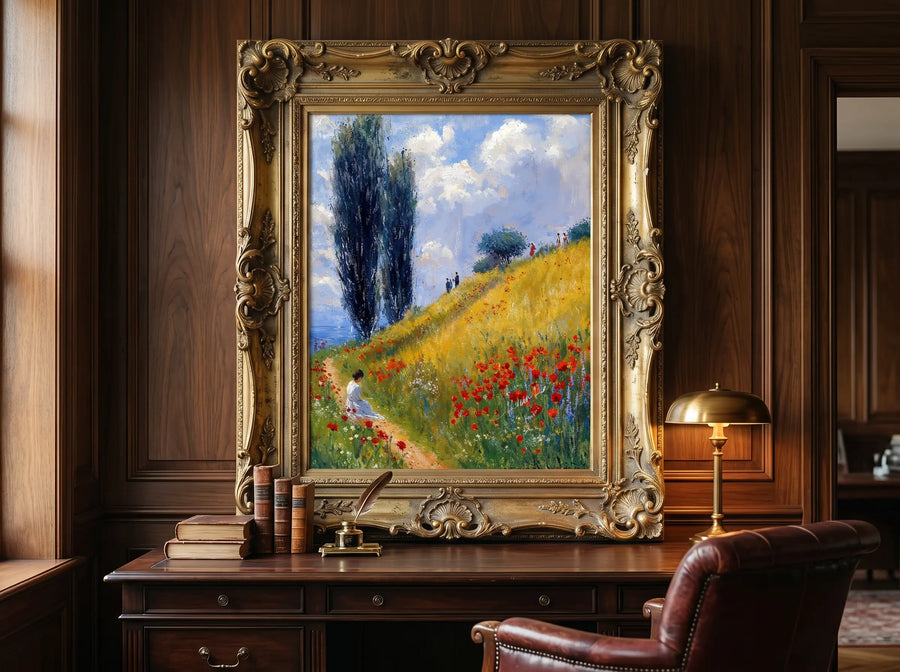
Rose Garden brings saturated roses, greenery, and a sunlit garden path into the room. It is currently available in Archival Matte Paper and Gallery Wrapped Canvas, from 8×10 through 24×36.
Should Dining Room Art Match the Furniture?
Not exactly. Trying to match every color in a dining room can make the space feel overly coordinated. A better approach is to create a relationship.
A warm wood table can connect naturally with artwork containing amber, rust, gold, terracotta, or deep green. A cooler or brighter room may benefit from coastal blue, turquoise, green, pale sky, or fresh floral color. You can also deliberately use contrast.
For a deeper room-by-room color guide, see Color Psychology in Wall Art.
Archival Matte Paper or Gallery Canvas?
Choose archival matte paper if you want:
- framing flexibility;
- a more traditional presentation;
- the ability to coordinate the artwork with existing frames;
- a refined gallery or formal-dining-room look.
Choose gallery canvas if you want:
- a stronger object-like presence;
- no separate frame decision;
- a ready-to-hang presentation;
- more visual depth on a larger wall.
Not every Art Academi artwork offers both formats, so always verify the options on the individual product page. For a deeper comparison, see Fine Art Paper vs Canvas Prints.
Common Dining Room Wall Art Mistakes
Choosing art that is too small
A small piece surrounded by a large amount of empty wall can look accidental. If you love the artwork but the available size feels too small, consider pairing it with another compatible work instead of forcing one piece to carry the entire wall.
Hanging it too high
Art should relate visually to the furniture and the seated dining experience.
Matching every color
Coordination is useful. Exact duplication is not necessary.
Choosing art only because it shows food or wine
Dining-room art does not need to depict dining. Landscapes, gardens, architecture, coastal scenes, and atmospheric works can create a much more distinctive room.
Buying before checking scale
Always mock the dimensions on the wall first.
Dining Room Wall Art: A 60-Second Decision Guide
| If your dining room is… | Consider… |
|---|---|
| Small or intimate | 11×14 or 16×20 |
| Built around a main focal wall | 24×36 |
| Very wide | Pair or coordinated grouping |
| Warm and traditional | Mediterranean, garden, countryside |
| Bright and airy | Coastal, floral, open landscapes |
| Formal | Framed archival matte paper |
| Relaxed and contemporary | Gallery canvas |
| Visually busy already | One calm statement piece |
| Very neutral | More colorful artwork |
Find Artwork for Your Dining Room
The best dining-room art should feel like it belongs to the room — not simply because it matches the furniture, but because it contributes to the atmosphere you want people to experience there.
Start with scale. Then think about mood. Then choose the artwork that makes the room feel more complete.
Explore the Art Academi Dining Room Wall Art collection, featuring fine-art prints and selected gallery-canvas options by Kevin Kia.
Frequently Asked Questions
What size artwork should go above a dining room sideboard?
A useful starting point is artwork or a grouping that visually occupies roughly 60–75% of the furniture width. Treat this as a starting guideline rather than a strict rule, and always test the dimensions on your wall.
Should dining-room art be centered on the wall or the furniture?
When artwork hangs above a sideboard or buffet, centering it with the furniture usually creates a stronger relationship than centering it to the entire wall.
Can I use one 24×36 artwork in a dining room?
Yes. A 24×36 piece can work well as a primary focal point in many dining rooms. On a very wide wall or long sideboard, however, a pair or grouping may create better scale.
Is canvas good for a dining room?
Yes. Gallery canvas can create a strong ready-to-hang focal point. Archival matte paper is often better when you want a framed or more traditional presentation.
Does dining-room art need to match the table?
No. The artwork should relate to the overall room, but it does not need to repeat the exact furniture colors. Harmony or deliberate contrast can both work.
Art worth living with


